
Fiber Optic Inverter: How It Works in Night Vision Devices
Fiber Optic Inverter - the Work Mechanism of Night Vision Devices
A night vision instrument is not a simple light amplification device. Prior to an image landing on your eye, it might be necessary for the picture to be flipped upside down.
The inverter performs this function. Its physical dimensions are very small and it is usually made in Japan by precision-fusion technology of glass pieces.
If you remove the fiber optic inverter the image through the night vision scope will be upside down.
What Exactly Do Fiber Optic Inverters Do?
Metal phosphors that are hit by high-velocity electrons emit light, but this way they only form an inverted (upside-down) image. Therefore inverting such a picture by physically spinning the whole image (without losing any light or detail) using the light-conducting properties of glass fibers becomes a must. This is achieved by the inverter that rotates the light 0 degrees as it travels through million of tiny glass fibers, each one is twisted at the same angle inside. Thus the bundle of fibers is a single fused glass.
The final product will be a very high quality, correctly rotated image as the result, which is achieved optically without electronics components, moving parts or extra power consumption.
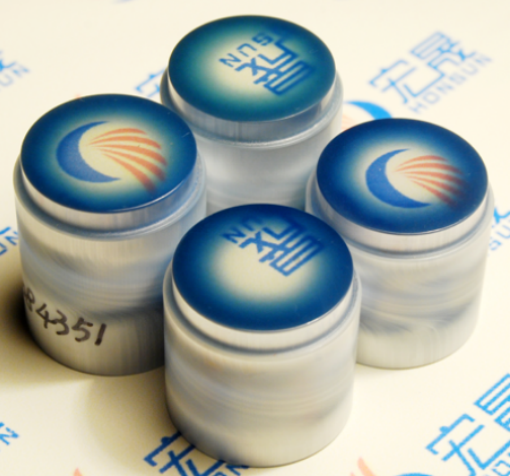
Key Specs Buyers Should Check
The performance of an inverter varies significantly depending on the product. So when you're getting one to be a part of a tube assembling process, it's the numbers below that will give a real measure of the product quality:
Resolution is expressed as lp/mm; high-grade tubes would be requiring at least 60 lp/mm.
Twist angle consistency is crucial, if twisting the inverter to different angles causes image smeering.
Transmission efficiency refers to the degree loss of light and thus the gain of the system as a whole.
EMA quality describes the quality of extra-mural absorber between fibers to suppress the halo and crosstalk.
The dimensions of diameter and length of a part must meet a certain tube design, generally 18mm or 25mm.
Where Fiber Optic Inverters Are Used
There's one major area where these items find their place in — military and安防 equipment night vision — monoculars, goggles, and weapon sights. Besides the above, they also can be found in the areas of diagnostic imaging, low-light security cameras, and the equipment that needs a compact image reversion system without moving parts and electronics.
How HONSUN Builds Them
At HONSUN fiber optic inverters being drawn, fused and polished in our facility are part of fiber optic components that we manufacture alongside fiber optic plates, fiber optic tapers, and fiber optic plates. Having the production line include all necessary drawing processes (fibring, twist control) ensures that we deliver very consistent quality, both from lot to lot, and also tube assemblers that check for resolution and MTF will be able to appreciate it right away.
We provide OEMs from diverse sectors like night vision, medical devices, and industrial imaging, with tubes of different dimensions, surface treatments, etc. as per request.
Need a Fiber Optic Inverter for Your Project?
To know what's best match for your optical system, simply send your tube size and resolution requirements and our team will suggest the suitable model if you allow us to use your drawing. Or in case there isn't a suitable model, we will have our technicians develop one to your exact specifications. You can find us at www.gz-honsun.com or reach out to us to get samples and quotation.