
What is AVG (Anti-Vignetting Glass)?
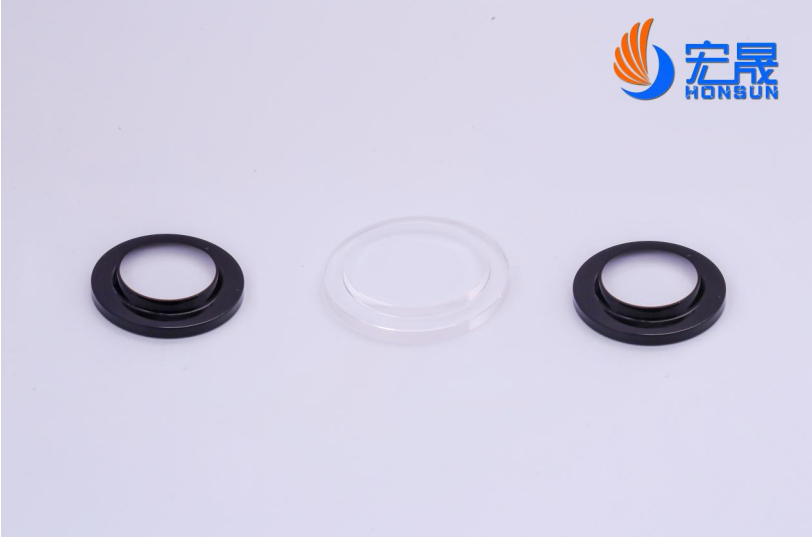
AVG (Anti-Vignetting Glass)— also known as the anti-halation input window or anti-vignetting cathode window— is a precision optical component seated at the very front of a night-vision image intensifier tube. Far from being a simple protective cover, it serves as the "gatekeeper" that determines how cleanly and efficiently a night-vision device converts scarce photons into a usable image.
Core Function in Night-Vision Systems
In micro-channel plate (MCP) image intensifiers, the AVG is bonded directly to the photocathode layer. Its engineering is deceptively simple but optically critical:
Central High-Transmission Zone
The clear aperture (center bore) delivers ≥92% transmission across 350–1000 nm (visible + near-IR). This ensures maximum photon flux reaches the photocathode, directly governing the device’s sensitivity and detection range.
Peripheral Light-Trap (The "Anti-Vignetting" Effect)
Outside the active field, the glass substrate integrates a deep-black absorption layer that suppresses stray light by >99.5%. Reflections from lens barrels, tube housings, or off-axis bright sources are swallowed before they can bounce onto the phosphor screen — eliminating halo, veiling glare, and edge fog.
Vacuum Seal & Cathode Substrate
The monolithic stepped glass acts as both the vacuum envelope seal (indium-bonded to the tube) and the mechanical support for the photocathode film, sustaining long-term cathode stability.
Why "Anti-Vignetting"?
In classical optics, vignetting means peripheral illumination fall-off. In night-vision terminology, however, AVG addresses halation / luminous haze — the glowing aura around bright objects caused by internal stray light. By absorbing rather than reflecting these rays, the AVG prevents contrast loss and keeps the image crisp from center to edge.
Key Benefits at a Glance
Feature | Performance | User Impact |
Broadband AR (350–1000 nm) | Tavg ≥92% | Brighter image, longer viewing distance |
Edge blackening | Stray-light absorption ≥99.5% | No halo, higher SNR, clearer details |
Integrated cathode platform | Vacuum-compatible, low outgassing | Extended tube life, stable sensitivity |
Applications
AVG is mission-critical in:
Gen-II / Gen-III / Gen-IV image intensifier tubes
Military night-vision goggles & weapon sights
Low-light surveillance & astronomy detectors
Precision anti-vignetting glass from [Your Company Name] is engineered to turn microscopic photons into tactical clarity. Contact our technical team for custom dimensions and cathode-compatible coatings.
FAQ
Q: What is the main purpose of anti-vignetting glass?
A: The main purpose of Anti-Vignetting Glass (AVG) is to act as the front input window of a night-vision image intensifier tube—allowing maximum useful light (350–1000 nm) to reach the photocathode while absorbing stray light at the periphery so it never degrades the image. It is both an optical performance component and the vacuum-sealed substrate for the photocathode.
Q: Where can you use anti-vignetting glass?
A: AVG is used inside Gen-II, Gen-III, and Gen-IV image intensifier tubes for micro-light night vision—typically in military night-vision goggles, weapon sights, low-light surveillance cameras, and scientific low-light detectors such as astronomy sensors.
Q: How does anti-vignetting glass improve image quality?
A: It improves image quality in three ways: (1) the central clear aperture delivers ≥92% broadband transmission so more photons hit the photocathode for higher sensitivity; (2) the peripheral blackened zone absorbs >99.5% of stray/reflected light, eliminating halos, veiling glare, and edge fog; (3) by cutting background stray light, it raises the signal-to-noise ratio and keeps contrast uniform from center to edge of the screen.
Q: Can anti-vignetting glass help with lens vignetting?
A: Not directly. Classical “lens vignetting” (natural fall-off of light at the frame edges due to optics geometry) is a lens-design issue. AVG targets halation/vignetting-type haze caused by internal stray-light bounce inside the intensifier tube. It does not fix a camera lens’s optical vignetting, but it prevents the tube itself from adding glow or gray-out that looks like worsened vignetting.
Q: Why should you choose our anti-vignetting glass?
A: Our AVG (Hongsheng Optoelectronics) is engineered as a monolithic stepped window with broadband AR performance (≥92% Tavg, 350–1000 nm), edge light-trap absorption ≥99.5%, and vacuum-grade compatibility for photocathode deposition. We support custom dimensions, cathode-compatible coatings, and strict outgassing control—so your image intensifier tubes get higher yield, longer cathode life, and cleaner night-vision output.